X-Ray Screening at Airports: How It Works and Why It Matters
Airport X-ray screening is an important part of aviation security. It helps security personnel examine baggage and cargo for prohibited or potentially dangerous items without opening every bag. By producing images of the contents, an X-ray scanner supports faster, more thorough checks while helping keep passengers, staff and aircraft safe.
What Is an Airport X-Ray Scanner?
An airport X-ray scanner is a security device that uses controlled X-rays to create an image of the contents of a bag, parcel or other item. The item passes through the scanner on a conveyor belt, while the system records how different materials absorb the X-rays. The resulting image helps a trained operator identify objects that may require closer inspection.
Depending on the airport and screening point, scanners may be used for cabin baggage, checked baggage, parcels or air cargo. X-ray screening of baggage is different from passenger body screening, which uses separate equipment and procedures.
How Does Airport X-Ray Screening Work?
- Items enter the scanner: A bag or parcel is placed on the conveyor belt and moves through the inspection tunnel.
- X-rays pass through the item: The system measures how much of the X-ray energy is absorbed by the materials inside.
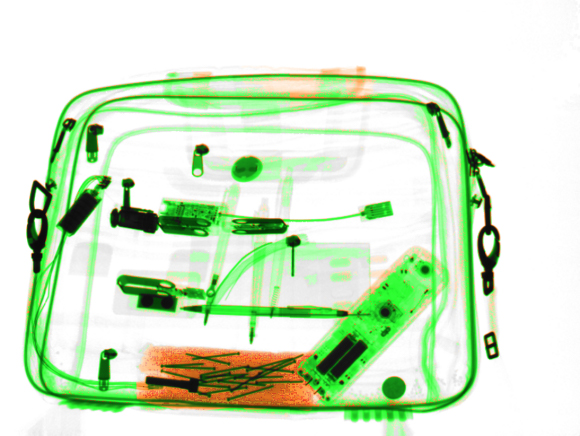
- An image is produced: The scanner displays an image that can help distinguish objects and materials. Some systems provide views from more than one angle.
- The image is reviewed: Trained security staff assess the image for items that may need further examination.
- Additional checks may follow: If something is unclear or requires attention, staff may conduct a secondary inspection in line with airport procedures.
What Can X-Ray Scanners Detect?
X-ray scanners can help operators identify objects such as tools, electronic devices, dense materials and shapes that may warrant further inspection. Modern systems may include image-enhancement or automated detection features to support the screening process.
However, an X-ray image is not a guarantee that every item will be identified automatically. Image interpretation, equipment performance and the overall screening procedure all matter. When an image is unclear, a secondary check may be necessary.
Types of Airport X-Ray Systems
- Cabin baggage scanners: Used to screen passengers’ hand baggage at security checkpoints.
- Checked baggage screening systems: Designed to inspect luggage travelling in an aircraft’s hold. These systems may form part of a larger, automated screening process.
- Dual-view scanners: Produce images from different angles, which can help operators assess the contents of a bag.
- Computed tomography (CT) systems: Create three-dimensional images of baggage contents. Their use and the procedures around them depend on the airport and applicable requirements.
- Cargo and parcel scanners: Used to inspect goods and shipments before they are transported by air.
Are Airport X-Ray Scanners Safe?
X-rays are a form of ionising radiation, so airport screening equipment is designed with shielding and safety controls to limit exposure outside the scanner tunnel. Systems are also subject to operating, maintenance and inspection procedures. Airport staff should follow the equipment manufacturer’s instructions and the relevant safety requirements.
For passengers, baggage scanners are designed to screen belongings rather than people. Passing an item through a baggage scanner does not make it radioactive. Anyone with a specific concern about screening equipment can speak with airport staff before screening.
Tips for Passengers
- Follow the instructions displayed at the security checkpoint and those given by airport staff.
- Place baggage and personal items on the conveyor belt as directed.
- Keep prohibited items out of cabin baggage and check the latest rules for your airline, airport and destination.
- Be prepared for staff to request a closer inspection if an image needs clarification.
- Check current guidance on liquids, electronics and other items before travelling, as procedures can vary.
The Role of X-Ray Screening in Airport Security
X-ray screening is one part of a wider airport security programme. It works alongside staff training, access control, physical inspections and other security measures. Reliable equipment, regular maintenance and consistent procedures help airports manage passenger and baggage screening efficiently.
As airport technology develops, newer imaging systems may provide clearer views and support more streamlined screening. Even with advanced equipment, trained personnel and well-managed procedures remain essential to effective airport security.
Airport X-Ray Screening in India: 5 Frequently Asked Questions
- How does an airport X-ray scanner work?
- Are airport X-ray scanners safe for passengers and their belongings?
- What items can airport X-ray scanners detect?
- Can I carry electronic devices and liquids through airport X-ray screening in India?
- What happens if an airport X-ray scanner flags something in my baggage?
How does an airport X-ray scanner work?
An airport X-ray scanner checks the contents of baggage without opening it. As a bag passes through the scanner on a conveyor belt, controlled X-rays travel through it and the system measures how different materials absorb them. This information is used to create an image for trained security staff to review. If an item is unclear or requires further attention, staff may carry out an additional inspection.
Are airport X-ray scanners safe for passengers and their belongings?
Yes. Airport X-ray baggage scanners are designed with shielding and safety controls to limit radiation exposure outside the scanner, and they screen belongings rather than passengers. Passing your bag through a scanner does not make it radioactive. These scanners are also designed to handle everyday travel items, but follow airport guidance for sensitive equipment or special belongings, and ask security staff if you have any concerns.
What items can airport X-ray scanners detect?
Airport X-ray scanners can help security staff identify the contents of baggage, including electronic devices, tools, liquids, dense materials and objects with unusual shapes. The images may highlight items that need further inspection, but scanners do not automatically identify every object or determine its purpose. If something is unclear or requires attention, airport staff may carry out an additional check in line with security procedures.
Can I carry electronic devices and liquids through airport X-ray screening in India?
Yes, you can generally carry permitted electronic devices and liquids through airport X-ray screening in India. At the security checkpoint, staff may ask you to remove a laptop or other large electronic device from your bag and place it in a separate tray; follow the instructions at your airport, as procedures can vary. Liquids in cabin baggage are generally limited to containers of up to 100 ml, packed in a transparent, resealable bag, with allowances or procedures for items such as essential medicines and baby food. Check the latest airport and airline guidance before travelling, and declare any item if requested.
What happens if an airport X-ray scanner flags something in my baggage?
If an airport X-ray scanner flags something in your baggage, security staff may ask to inspect the item more closely. This could involve a visual check, asking you to open your bag or using additional screening equipment. A flagged image does not necessarily mean you have done anything wrong; it may simply be unclear or require verification. Follow the staff’s instructions and avoid handling the item until they ask you to do so.